USCGC Tornado
Not Without HopeUSCGC Tornado is the Coast Guard cutter whose intervention resolves the search for four missing boaters in the Gulf of Mexico. Its decisive significance lies in the contrast between the vast, shifting sea and the disciplined, collective act of looking: after the capsizing of Marquis Cooper's 21-foot Everglades boat, the cutter must find a small overturned hull without a distress signal, then convert a fleeting orange-and-white speck into the rescue of Nick Schuyler.
Mission and Setting
USCGC Tornado was originally on routine patrol in the Florida Straits, off the coast of Cuba, operating on one engine in quiet seas on a Sunday afternoon. Its ordinary work involved law enforcement—restricting the movement of illegal aliens and drugs, preventing illegal fishing, and checking commercial and recreational vessels for safety compliance. At 2:40 p.m. on March 1, however, Lieutenant Commander Patrick Peschka received orders to divert the cutter 230 miles north toward a search-and-rescue operation off the coast of Tampa–St. Petersburg. Some crew members learned only through the Internet that the mission concerned four missing football players.
The search was complicated before the cutter reached the area. Marquis Cooper's fishing boat had capsized after its anchor line, improperly tied to an eye bracket on the port side of the transom, was pulled tight while the motor was throttled forward. The stern submerged, the bow rose, and the vessel overturned before the men could make a Mayday call. Once the boat was cut free, the survivors could not right it: the submerged center console acted as a resistant rudder, while waves denied them leverage. The Coast Guard therefore had to search for a low, unstable target whose position was uncertain and whose occupants might be in the water or separated from the hull.
The absence of an emergency position-indicating radio beacon made the problem more severe. An EPIRB could have transmitted the vessel's position and identity through the international satellite search-and-rescue system; instead, the Coast Guard had to estimate drift through wind, waves, and currents. Captain Timothy Close compared the task to dropping ten thousand rubber ducks into the water and calculating where they might move. If the boat was overturned and still afloat, searchers might see only a fingernail of white hull among hundreds of thousands of whitecaps.
Transit Through the Storm
USCGC Tornado had three of its four engines operating and increased speed to twenty-three or twenty-four knots while heading east of the Dry Tortugas. Peschka knew that bad weather was building in the Gulf of Mexico. After roughly ninety minutes, winds rose from ten to fifteen miles per hour; by late Sunday afternoon they reached twenty to twenty-five miles per hour, and swells grew from three feet to eight feet. The cutter reduced speed to ten or twelve knots rather than drive through the building seas at full pace.
Between midnight and two on Monday morning, the storm intensified again. Winds reached thirty-five miles per hour and swells rose to twelve feet, forcing the cutter to slow further. Even aboard the 179-foot vessel, crew members had to hold on to avoid being thrown across the deck, and some became seasick. The weather physically damaged the cutter: an ammunition box three feet high and three feet wide tore loose from twelve half-inch bolts securing it to the bow, metal components bent under the waves, and parts later had to be welded back together. Crew members even placed boots beneath their mattresses to create an incline that rolled them toward the walls of their narrow bunks while they tried to sleep.
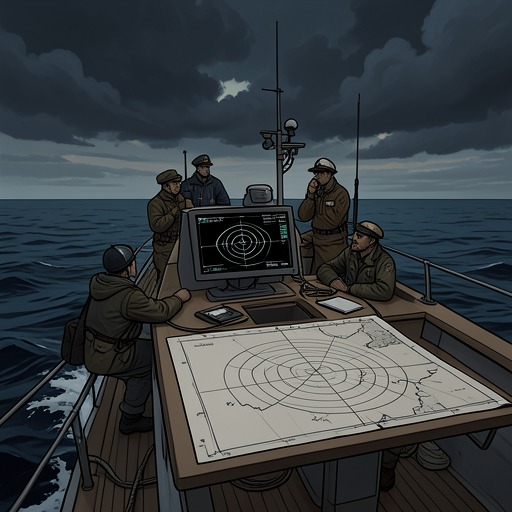
By three or four Monday morning, conditions began to improve, although swells still reached six feet. At 7:45 a.m., USCGC Tornado began its initial search. The pattern moved west for eight to ten miles, turned north by a spacing interval of a quarter mile to a mile, and then proceeded east in a straight-line creep. The method resembled covering a football field from end zone to end zone, advancing in measured strips rather than relying on a single sweep or a lucky glimpse.
Search and Detection
The cutter's search depended on trained attention as much as on its size and equipment. Normally three lookouts scanned forward, starboard, and port. A capsized twenty-one-foot boat or a person sitting on it could disappear behind waves, while whitecaps and floating debris—from milk jugs to old rafts and refrigerators—could resemble a possible target. The moving ship, moving water, and unstable horizon made the task unlike looking across land or from a car on a highway. Peschka noted that even a beach ball visible for miles on a flat day might vanish one hundred yards away when it dropped into a trough, met harsh light, or blended into the sea.
Chief Boatswain's Mate Michael Briner brought sixteen years of Coast Guard experience to the watch. He knew that peripheral vision could locate objects more quickly than direct staring, and the service expected anyone on the bridge—even someone merely taking a cigarette break—to lend an extra set of eyes. At 11:43 a.m., about thirty-eight miles west of Tampa, Briner saw a speck of orange beside a white wave that did not break and disappear. At first it seemed an odd place for a buoy, but he realized there were no buoys in that open water. He alerted the bridge and fixed on the object roughly five hundred yards off the starboard side.
The object was Nick Schuyler, seated on the overturned boat. The orange life jacket and orange winter jacket helped distinguish him from the sea, but the waves repeatedly hid him and exposed him again. Peschka later credited Schuyler with doing the right thing by wearing bright colors and remaining on the back of the boat; Briner emphasized how narrowly the detection succeeded, observing that a different wave crest might have carried the cutter past him.
Rescue Operation
A general alarm sounded, and the cutter prepared its twenty-three-foot rescue boat, a hybrid craft with a rigid fiberglass hull and an inflatable collar. David Earles, the rescue swimmer, hurried from the mess hall after finishing lunch, changed into a short-sleeved wetsuit, and secured a harness attached to a rope. Within minutes, two stern doors opened and the rescue boat slid down a ramp into the water.
The four-person rescue crew approached while keeping the survivor in sight as he vanished behind one wave and reappeared beyond it. He sat with his head lowered and shoulders slouched, holding the motor. He wore gloves, an orange life jacket, an orange winter jacket, and a hooded sweatshirt. Earles, twenty-five and less than two years into his Coast Guard service, had never before been called upon to make a water rescue; he had expected that the missing boaters would be located and lifted by helicopter. Instead, he entered the water, reached Schuyler, handed him a flotation device, and directed him to float on his back while the crew reeled them in along the line attached to Earles's harness.
Only twelve minutes passed between Briner's sighting and Schuyler's arrival aboard the rescue boat. The speed of that sequence depended on several coordinated layers: the lookout's peripheral observation, the bridge's alarm, the rescue boat's launch, Earles's physical approach, and the crew's line system. The cutter did not merely appear at the end of the search; it transformed a fragile visual identification into a controlled recovery.
Medical Handoff and Significance
After the rescue, Adam Best, USCGC Tornado's emergency medical technician, and Earles guided Schuyler to the executive officer's bathroom. They dried him, removed his wet clothes, dressed him in Coast Guard coveralls, wrapped him in wool blankets, and gave him sandals normally issued to migrants recovered from rafts or small boats. The largest pair aboard was size twelve, while Schuyler wore size fifteen. His temperature was 89.5 degrees, far below the normal 98.6; his breathing was labored, his lips were turning blue, his skin was cool and clammy, and he appeared to be entering the early stages of shock. Minor cuts on his legs were aggravated by salt water, and he complained of leg pain.
Best's questions showed that Schuyler remained mostly coherent: he knew his name, location, and the month, though he could not immediately remember who was president of the United States. He could laugh and then become serious as he recalled what had happened. Briner asked his name again and confirmed that he had been with NFL players, because the crew needed to ensure that the cutter had found the correct missing-boat case. USCGC Tornado then phoned the Coast Guard station in St. Petersburg, where an officer reported to Captain Timothy Close, “We got him,” before the officers shifted to secure communications.
The cutter's role therefore links two different kinds of uncertainty. The overturned boat had been produced by a preventable chain involving anchor placement, engine power, and insufficient slack, while the rescue depended on weather-tolerant equipment, trained observation, communications, and medical readiness. The same storm that made the search nearly impossible also battered the rescuing ship, yet USCGC Tornado continued the patterned search until a small patch of orange broke through the whitecaps. Its lasting place in the account is not as a symbol of effortless rescue, but as the recovery system that succeeded after human preparation and the sea's conditions had aligned disastrously.